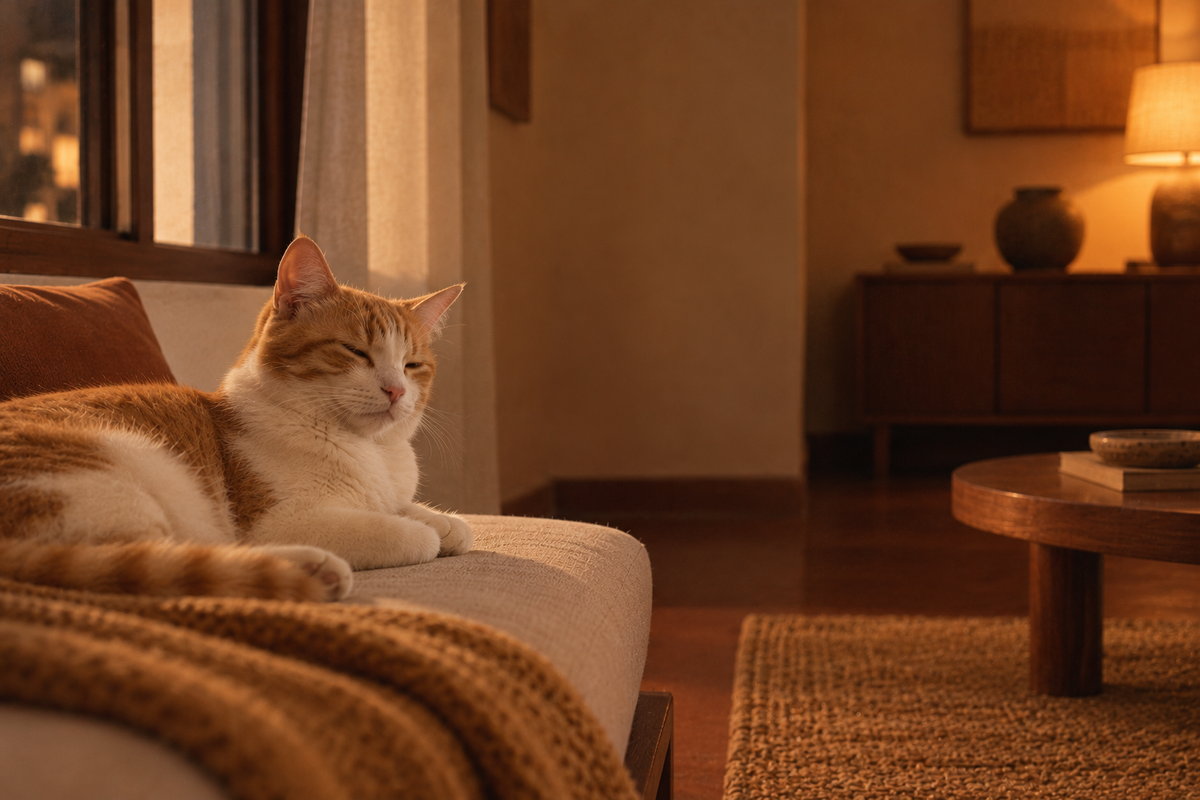
The highest compliment a cat pays is to close their eyes in front of you. Slowly.
The short version
A slow blink is a relaxed, friendly signal. It's widely read as trust.
You can send one back, and cats often answer.
Staring is the opposite. In cat terms, it's a challenge.
What it looks like
A cat looks at you, then their eyes narrow and close gently, stay closed for a moment, and open again, softer than before. It isn't sleepiness and it isn't a squint. It is a cat choosing to be unguarded in your presence.
For an animal that stays alert by default, closing your eyes near someone is not a small thing.
You can answer
A study published in 2020 by researchers at the Universities of Sussex and Portsmouth found that cats were more likely to slow-blink at people who slow-blinked at them first, and more likely to approach a stranger who had done so.
To try it: soften your face, look at your cat without staring, let your eyes half close, hold them there for a second or two, then open them and glance slightly away. Wait. Cats reply on their own schedule.
Staring is a challenge. Blinking is a truce.
The rest of the vocabulary
Tail up, sometimes with a slight hook at the tip, is a greeting. Head bumps and cheek rubs leave scent from glands in the face; you are being marked as familiar. Kneading is a comfort behaviour left over from kittenhood.
A belly on display means a cat feels safe. It is not, usually, an invitation to touch it. Many cats will grab the hand that tries.
Ears turned sideways or flattened, a twitching or thrashing tail, and skin rippling along the back mean it's time to stop whatever you are doing.
Worth knowing
With a nervous or new cat, a slow blink from across the room is one of the gentlest introductions you can make. No reaching, no hovering. Blink, look away, and let the cat decide how close to come.
In a world run by cats, this is the handshake. Learn it.
Sources
- Humphrey, T. et al. (2020). The role of cat eye narrowing movements in cat–human communication. Scientific Reports.
Checked against published veterinary guidance. It is general information, not a substitute for your vet.
Catlas entries are general guidance, not a substitute for your veterinarian.